
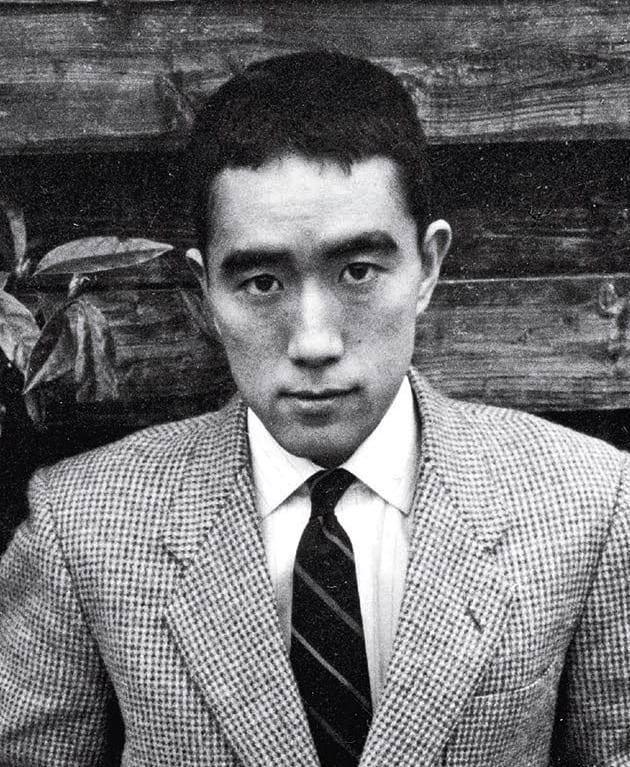
The previous piece read the three sentences that open Yukio Mishima’s Shiosai (The Sound of Waves, 1954) for their style. Here we use the same three sentences to explain, from scratch, how a Japanese sentence is built. Minimal jargon, everything set against English.
Uta-jima has a population of fourteen hundred and a circumference of less than one ri. There are two places on Uta-jima where the view is at its most beautiful. One is Yashiro Shrine, built near the island’s summit, facing northwest.
— Yukio Mishima, Shiosai, chapter 1 (working translation; one ri ≈ 4 km)
1. The backbone — the predicate comes last
In English the verb sits in the middle: The shrine|is|near the peak.
Japanese is different. The “is” (da / desu / de aru) and every verb come at the very end of the sentence.
This is the backbone. “Uta-jima wa … de aru,” “two places aru,” “Yashiro Shrine de aru” — all three sentences close with the predicate.
2. Particles — tags you stick onto the back of a word
English shows a word’s role by position (subject before the verb, object after). Japanese instead sticks a small tag onto the back of the word. These tags are called particles.
From the passage: “Uta-jima wa” (topic), “places ga” (subject), “Uta-jima ni” (place), “shima no itadaki” (the island’s summit), “hokusei ni mukatte” (facing northwest). Read the tag and you know what the word is doing.
wa vs. ga (the classic stumbling block)
- wa = takes up a topic you already know. “Uta-jima wa (the Uta-jima you know of) … is a small island.”
- ga = puts something new on the table. “(On Uta-jima) there are two places ga” — places appears here for the first time, so ga.
Sentence 1 sets up “Uta-jima wa” as topic; sentence 2 brings in new information with ga; sentence 3 makes one of them the topic again with “one wa.” This wa → ga → wa back-and-forth is how the sentences link up without restating the subject.
3. Two basic sentence patterns
Most expository Japanese sentences are one of these two shapes.
- Pattern A “A wa B da”: “Uta-jima wa … a small island de aru”; “one wa … Yashiro Shrine de aru.” It says what something is. da is casual, desu polite, de aru written and essayistic — Mishima’s choice here makes the prose sound as objective as an encyclopedia.
- Pattern B ”… ga aru”: “two places aru.” It reports that something exists. Use iru for people and animals, aru for things and facts.
4. Description goes before the noun
English adds description after the noun with a relative pronoun (which / that). Japanese places the description in front of the noun, as is.
Sentence 3 — “built near the island’s summit, facing northwest / Yashiro Shrine” — is exactly this shape. The place, the direction and “was built” all describe the noun “Yashiro Shrine” from the front. Sentence 1 does the same: “of a circumference under one ri / small island.”
5. The subject is often left out
If the topic is clear, Japanese does not state the subject. Sentence 3 is “(of Uta-jima’s two places) one is … Yashiro Shrine” — “of Uta-jima’s” is not written; the reader supplies it from the previous sentence. The fourth sentence (cut off in the page image) continues “the other is …”, again with no stated subject.
6. Tense sits on the last word — -ta = past / perfect
English marks time by changing the verb (build → built). Japanese adds -ta to the sentence-final word for past / perfect.
But in the passage, “built” (taterareta) sits inside the part that describes the noun “Yashiro Shrine.” A -ta in that position does not mean “they built it long ago”; it means “having been built, it now stands there” — a perfect / resultant state. Every matrix predicate (de aru, aru) is present tense, with no -ta. So the whole opening is a description of a scene in the present, with time held still.
7. Counting — number + counter word
To count things in Japanese you use a number + a counter word (a unit for counting). futatsu is “2 + -tsu” (the counter for general objects). Unlike English two, it can sit away from the noun, right before the verb.
“(On Uta-jima) two places ga futatsu aru” — “there are two places” also works, but the order “places, two, exist” highlights the number itself as new information.
In sum — the three sentences taken apart
| Sentence | Pattern | Skeleton |
|---|---|---|
| Uta-jima wa … a small island de aru. | A (A wa B da) | topic [Uta-jima wa] + [front description] + [small island] + predicate [de aru] |
| On Uta-jima … two places ga aru. | B (… ga aru) | place [Uta-jima ni] + subject [places ga] + number [futatsu] + predicate [aru] |
| One wa [built near the summit, facing NW] Yashiro Shrine de aru. | A (A wa B da) | topic [one wa] + [long description before the noun] + [Yashiro Shrine] + predicate [de aru] |
That is how a Japanese sentence is built: the predicate comes last; roles are shown by particle tags; description goes before the noun; a known subject is dropped; time is marked on the final word. Hold onto those five and Mishima’s opening is, grammatically, fully in view.
For the deeper stylistic reading, see the article on narration in Shiosai.
.jpg)